← Issues 1960 · This Year in Music
⬇ Download Desktop UK Music Archive ↗
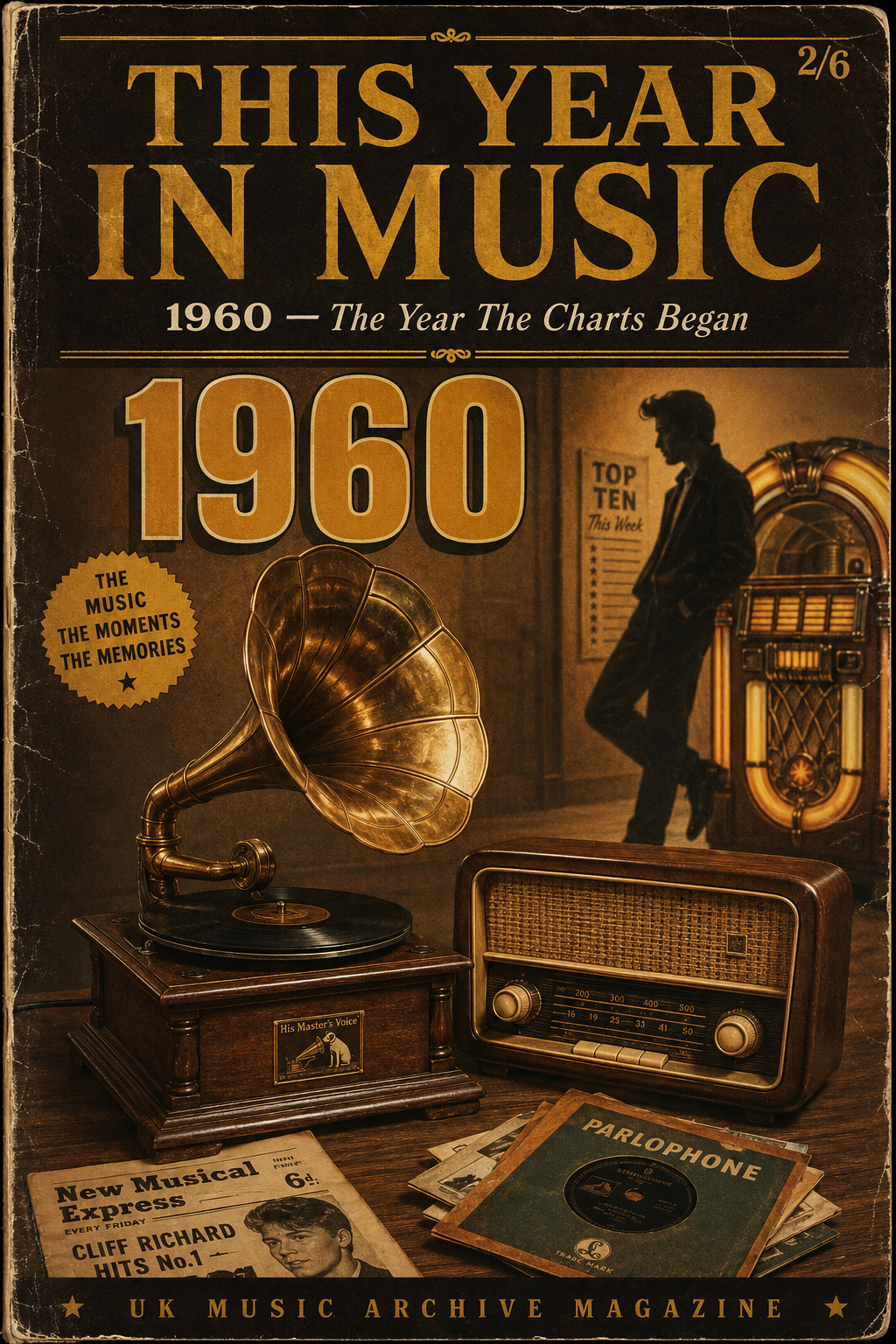
1960 Cover

Welcome to 1960

The year the charts began

1960 was the year British music found its voice. The post-war years were finally fading. Rationing had ended. The teenagers of the 1940s were now young adults with money in their pockets, and they wanted music that spoke to them — not their parents.

Elvis was in the army. Buddy Holly was gone. But rock 'n' roll wasn't dead — it was evolving. In Liverpool, a band called The Quarrymen had just changed their name to something catchier. Cliff Richard was Britain's answer to Elvis. The Shadows were defining the sound of British guitar music. And somewhere in a London coffee bar, a young musician named David Jones was watching it all unfold — he'd change his name to Bowie a few years later.

The UK singles chart as we know it — compiled by the NME and published weekly — was still in its infancy. But 1960 was the year it started to mean something. The year the British public decided what they wanted to hear, and the music industry started listening.

This is the story of 1960 — told through the songs that made it.

1960 by the Numbers

The year in stats
262
Songs Charted
178
Artists
52
Weeks of Charts
27
Different #1s

The Big Moments

What happened in 1960

January: The Navy Lark by The Michael Sammes Singers is the first #1 of the new decade. It's a novelty song. 1960 hasn't found its groove yet.

February: Elvis Presley's "It's Now or Never" — a reworking of the Italian song "O Sole Mio" — enters the chart. It will become his biggest UK hit, spending 8 weeks at #1.

April: Lonnie Donegan hits #1 with "My Old Man's a Dustman" — skiffle's last hurrah. The working-class humour resonates with a nation still adjusting to peacetime.

June: The Everly Brothers' "Cathy's Clown" — a perfect piece of harmony pop. It spends 7 weeks at #1 and proves American acts still rule the British charts.

August: Cliff Richard and The Shadows release "Please Don't Tease" — their third #1 in a year. British rock 'n' roll is officially a thing.

September: The Olympics in Rome. The Shadows' "Apache" — an instrumental that redefined what a guitar could sound like — is released. It reaches #1 and stays for 5 weeks. British guitar music is born.

December: Cliff Richard's "I Love You" is the Christmas #1. It's a ballad, not a rock 'n' roll song. The 60s are about to begin in earnest.

Did You Know?

The stories behind the stats
👑

Elvis's "It's Now or Never" spent 8 weeks at #1 in 1960 — the longest run of the year. It sold over 1 million copies in the UK alone. Elvis was in the US Army at the time, stationed in Germany.

🎸

The Shadows' "Apache" was originally written by Jerry Lordan, who also wrote "Apache" for Cliff Richard. When Cliff turned it down, The Shadows recorded it themselves. It became one of the most influential guitar instrumentals ever.

🇬🇧

Lonnie Donegan was the king of skiffle — a DIY music movement that inspired a generation of British teenagers to pick up guitars. John Lennon's first band was a skiffle group called The Quarrymen.

🎤

Cliff Richard's "Please Don't Tease" was his third #1. He was 19 years old and already Britain's biggest pop star. His clean-cut image made him a favourite with parents as well as teenagers.

📻

The NME chart — the official UK singles chart — was published weekly in the New Musical Express. In 1960, it was the definitive source for what was selling. Radio Luxembourg was the only station playing the hits.

🎬

"A Mess of Blues" by Elvis was the B-side to "It's Now or Never". It hit #2 — the highest-charting B-side of the year. The King could put anything on a record and make it a hit.

Month by Month

The #1 that ruled each month
January
The Navy Lark
The Michael Sammes Singers
February
It's Now or Never
Elvis Presley
March
It's Now or Never
Elvis Presley
April
My Old Man's a Dustman
Lonnie Donegan
May
Stuck on You
Elvis Presley
June
Cathy's Clown
The Everly Brothers
July
Cathy's Clown
The Everly Brothers
August
Please Don't Tease
Cliff Richard & The Shadows
September
Apache
The Shadows
October
Apache
The Shadows
November
Apache
The Shadows
December
I Love You
Cliff Richard

Longest #1 Runs

Who stayed at the top longest

Elvis Presley — "It's Now or Never" — 8 weeks (Feb-Apr)

The Everly Brothers — "Cathy's Clown" — 7 weeks (Jun-Jul)

The Shadows — "Apache" — 5 weeks (Sep-Oct)

Lonnie Donegan — "My Old Man's a Dustman" — 4 weeks (Apr-May)

Cliff Richard & The Shadows — "Please Don't Tease" — 3 weeks (Aug)

💡 The Elvis Effect

Elvis had three #1s in 1960 despite being in the army and not recording a single new song in the UK. "It's Now or Never," "Stuck on You," and "Are You Lonesome Tonight?" (which hit #1 in January 1961) all dominated while he was in uniform. The King was never more popular than when he was away.

The Year Britain Found Its Sound

1960 and the birth of British pop

1960 was a year of transition. The 1950s were over, but the 60s hadn't quite started. The music of 1960 was caught between two worlds — the old-fashioned variety of the post-war era and the teenage rebellion that was about to explode.

The Shadows — Britain's First Guitar Heroes

The Shadows were the backing band for Cliff Richard, but they were so good they became stars in their own right. Hank Marvin's Fender Stratocaster sound — drenched in echo, clean and melodic — defined the sound of British guitar music for the next decade. "Apache" wasn't just a hit. It was a blueprint. Every teenage boy who heard it wanted a guitar. A generation of British rock musicians — from Eric Clapton to Jimmy Page to Mark Knopfler — trace their inspiration back to that single instrumental.

Cliff Richard — The Safe Rebel

Where Elvis was dangerous, Cliff was charming. He didn't shake his hips. He didn't scandalise parents. He was rock 'n' roll for the polite young man. But that's not a criticism — Cliff's success proved that British pop could be commercially viable without copying American stars. He was the template for every British pop star who followed.

"1960 was the year British teenagers realised they didn't have to look to America for their music."

The Skiffle Hangover

Lonnie Donegan's "My Old Man's a Dustman" was the last big skiffle hit. Skiffle — a DIY genre played on washboards, tea chests, and acoustic guitars — had been the soundtrack of the mid-50s. It was cheap, accessible, and anyone could do it. John Lennon, Paul McCartney, and George Harrison all started in skiffle groups. By 1960, skiffle was dying. But the teenagers it had inspired were just getting started.

Top 10 of 1960

The songs that defined the year

10. The Everly Brothers — "Cathy's Clown"
Seven weeks at #1. The perfect harmony pop single. Don and Phil Everly's voices entwined around a song about heartbreak. It influenced The Beatles, Simon & Garfunkel, and every harmony duo that followed.

9. The Shadows — "Apache"
The most influential instrumental in British music history. Hank Marvin's twangy Stratocaster, a galloping rhythm, and a melody that's still instantly recognisable 65 years later.

8. Lonnie Donegan — "My Old Man's a Dustman"
The last great skiffle record. A comic song about a binman that captured the working-class humour of post-war Britain. It spent 4 weeks at #1 and is still a pub singalong staple.

7. Cliff Richard & The Shadows — "Please Don't Tease"
Cliff's third #1. Catchy, harmless, and perfectly produced. It's the sound of British pop finding its feet — not as raw as rock 'n' roll, not as square as variety music.

6. Adam Faith — "Poor Me"
Adam Faith was Britain's first teen idol — a handsome Londoner with a distinctive nasal voice. "Poor Me" spent 2 weeks at #1. He later became a respected actor and financial journalist.

5. Bobby Darin — "Mack the Knife"
A jazz standard from The Threepenny Opera, transformed into a swinging pop hit. It spent 1 week at #1 but its influence was enormous — a reminder that pop music could be sophisticated.

4. The Drifters — "Save the Last Dance for Me"
Written by Doc Pomus, who was confined to a wheelchair and watched his wife dance with others at their wedding reception. A beautiful, bittersweet song. It hit #2 in the UK.

3. Elvis Presley — "Stuck on You"
Elvis's second #1 of 1960. A rockabilly-tinged love song recorded before he left for army service. It's lighter than "It's Now or Never" but pure Elvis charm.

2. Cliff Richard — "I Love You"
The Christmas #1 of 1960. A tender ballad that shows Cliff moving away from rock 'n' roll and towards the middle-of-the-road pop that would sustain his career for decades.

1. Elvis Presley — "It's Now or Never"
Eight weeks at #1. A million copies sold. The biggest single of 1960. Based on an Italian opera aria, sung by a man in army uniform, loved by teenagers and their grandparents alike. It was the sound of a King who didn't need to be on a throne to rule.

One-Hit Wonders

The songs that came, went, and never came back

Johnny Preston — "Running Bear" (1960)
A story-song about a Native American Romeo and Juliet, complete with war whoops and a tragic ending. It went to #1 in the UK. Johnny Preston never repeated the trick.

The Michael Sammes Singers — "The Navy Lark" (1960)
The first #1 of the decade. A novelty song based on a BBC radio comedy show. It's a cheerful, nonsense tune sung by a vocal group who'd never have another hit.

Bert Weedon — "Guitar Boogie Shuffle" (1960)
Bert Weedon was a session guitarist who wrote a bestselling guitar tutorial book. This instrumental hit #10. He taught a generation of Britons how to play — including a young George Harrison.

Sunglasses After Dark — "Down by the Riverside" (1960)
A bizarre trad jazz novelty that somehow charted. It's the sound of 1960 before rock 'n' roll fully took over — old-fashioned, cheerful, and utterly forgettable.

The Sound of 1960

The genres that defined the year
30%
Pop / Ballad
25%
Rock 'n' Roll
20%
Novelty / Comedy
15%
Instrumental
10%
Other / Jazz

The Shadows

★ Artist Spotlight

Hank Marvin, Bruce Welch, Jet Harris, and Tony Meehan — four young men from London who became Britain's first instrumental supergroup. The Shadows started as Cliff Richard's backing band, but their sound was so distinctive they became stars in their own right.

Their 1960 instrumental "Apache" spent 5 weeks at #1 and changed British music forever. Hank Marvin's Fender Stratocaster — played through a Vox amplifier — created a clean, echo-laden sound that every British guitarist wanted to copy. The song was written by Jerry Lordan, a former member of The Michael Sammes Singers (yes, them).

The Shadows were the first British band to prove that instrumental music could be commercial. They influenced everyone from The Beatles to Dire Straits. When American musicians heard "Apache," they couldn't believe it was British. It sounded like nothing else.

The Shadows' legacy is immeasurable. They proved British musicians could be world-class. They created the template for the guitar band. And they did it all without their voices — because they didn't need them.

1960 in Context

What else was happening

In the UK: Harold Macmillan was Prime Minister, telling the nation they'd "never had it so good." The first episode of Coronation Street aired in December. The M1 motorway had just opened. The contraceptive pill was approved for use. Britain was entering a new age — and the music reflected it.

In music: In Liverpool, a band called The Beatles — formerly The Quarrymen — were playing in clubs and coffee bars. In London, the 2i's Coffee Bar in Soho was the epicentre of British rock 'n' roll. In America, Motown Records was just getting started. The 60s hadn't exploded yet. But the fuse was lit.

The Elvis Effect

How the King ruled from afar

In March 1960, Elvis Presley was still in the US Army, serving in Germany. He hadn't performed live since 1957. He hadn't released a new film. And yet he was the biggest-selling artist in the UK in 1960, with three #1 singles.

How? Because the songs he had recorded before his induction were being released strategically by RCA Records. "It's Now or Never" was a pre-recorded track, released in February 1960. "Stuck on You" followed in April. "Are You Lonesome Tonight?" was released in November and hit #1 in January 1961. The King was absent — but he was everywhere.

Elvis's army service actually boosted his popularity. The clean-cut image of a soldier doing his duty appealed to parents who had been suspicious of his hip-shaking. He became acceptable. Safe. And sales soared. The "dangerous" Elvis of the 1950s became the "beloved" Elvis of the 1960s.

🎵 The Italian Connection

"It's Now or Never" was based on "O Sole Mio," a Neapolitan song from 1898. The same melody was used for "There's No Tomorrow" by Tony Martin in 1949. Elvis heard it, loved it, and recorded his version. It became the biggest-selling single of 1960 in the UK.

The Rise of the Teenager

Pop music's new audience

1960 was the year the teenager became a consumer. Post-war prosperity meant young people had disposable income for the first time. They spent it on records, coffee bars, and fashion. The music industry realised that teenagers weren't just smaller adults — they were a market.

Cliff Richard, Adam Faith, and Billy Fury were the first British pop stars built specifically for teenage consumers. They were young, handsome, and non-threatening. They sang about love, heartbreak, and dancing. They didn't challenge authority — they just wanted to entertain. It was the birth of the teen idol. And it was the beginning of pop music as we know it.

Odd Facts

The weird stuff that happened
🎵 Random Trivia

Elvis's "It's Now or Never" was recorded in a single take at RCA Studio B in Nashville. The session lasted 4 minutes. It sold over a million copies in the UK — but Elvis never knew until he got out of the army.

🎸 Guitar History

The Shadows' "Apache" was originally written for Cliff Richard. He turned it down because he didn't think it was commercial. The Shadows recorded it themselves and it became one of the most influential instrumentals of all time.

📺 TV Moment

Cliff Richard appeared on The Perry Como Show in the US in 1960 — the first British pop star to reach an American TV audience. The performance was pre-recorded. Cliff lip-synced. America didn't care. They loved him anyway.

🔄 One-Take Wonder

Lonnie Donegan recorded "My Old Man's a Dustman" live in the studio — no overdubs, no edits. The laughter you can hear on the track is genuine. The band couldn't keep a straight face through the lyrics about finding a corset in the dustbin.

1960 at a Glance

The year in 60 seconds
🎵

Biggest song: "It's Now or Never" — Elvis Presley. 8 weeks at #1. Over a million copies sold.

💿

Biggest album: The album chart was still in its infancy, but Cliff Richard's "Me and My Shadows" was a major seller.

🏟️

Biggest gig: Cliff Richard and The Shadows at the London Palladium — the first rock 'n' roll show at the legendary venue.

🌟

Breakthrough artist: The Shadows — from backing band to guitar heroes in the space of a single instrumental.

🎬

Biggest film: "The Alamo" — John Wayne's epic. Not music-related, but the soundtrack by Dimitri Tiomkin was huge.

🇬🇧

Best selling single: "It's Now or Never" by Elvis Presley — the biggest-selling single of the year, and one of the biggest of the entire decade.

— End of Issue —