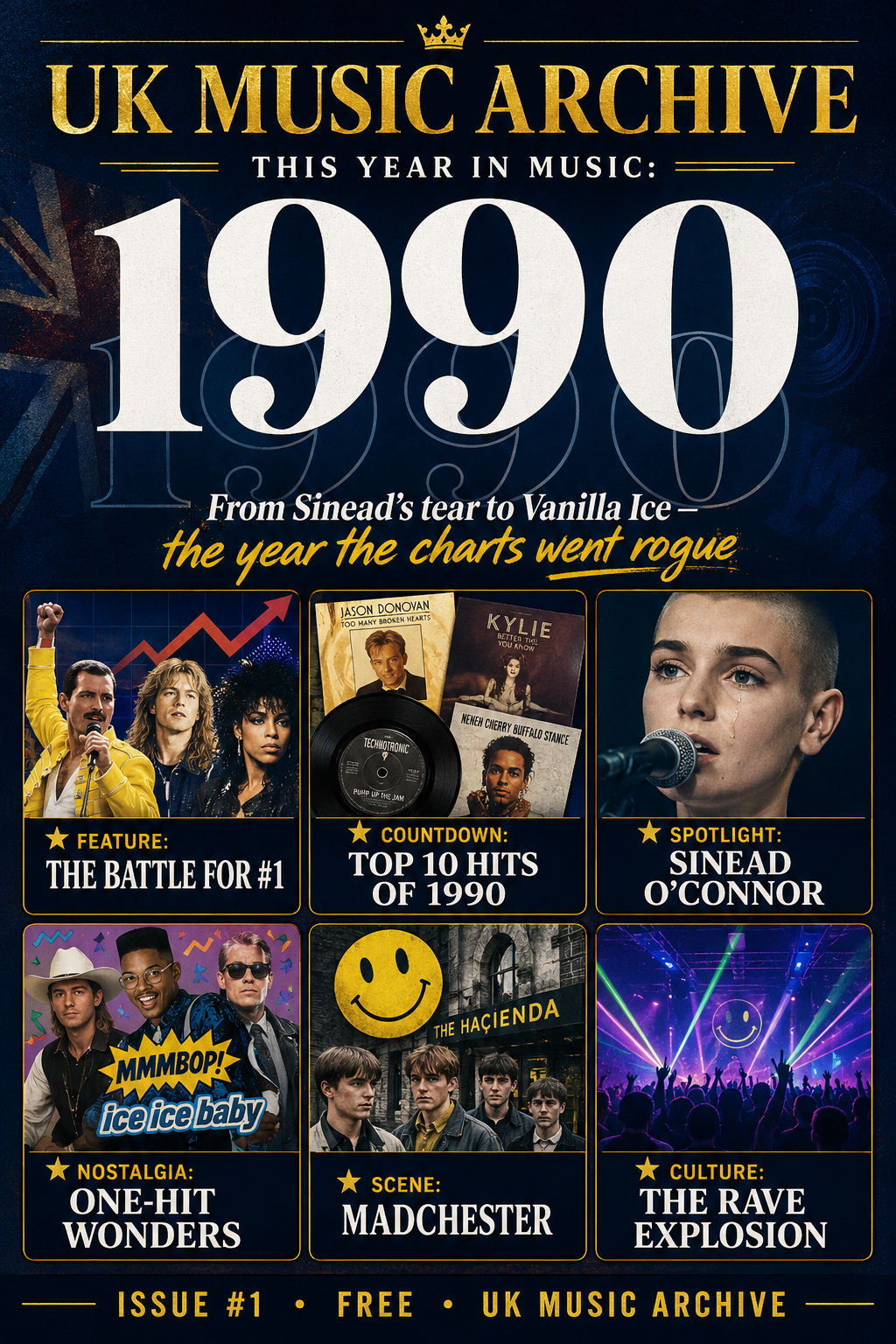
1990 Magazine Cover

Page 1 of 10

Welcome to 1990

The year the charts went rogue

1990 was a strange, brilliant year for British music. It began with a charity Christmas single at #1, peaked with a bald Irish woman crying about Prince, and ended with a rapper from Dallas telling us all to ice, ice, baby.

It was the year the old certainties fell away. Stock Aitken Waterman's grip on the pop charts loosened. Madchester bled into the mainstream. Dance music stopped being underground and started being everything. And somewhere in the middle, Elton John had the biggest hit of his career with a double A-side nobody saw coming.

This isn't a list of chart positions. This is the story of 1990 β€” told through the songs that made it.

1990 by the Numbers

The year in stats
347
Songs Charted
205
Artists
41
Weeks of Charts
31
Different #1s
πŸ’‘ Did You Know?

1990 had more #1 singles (31) than any other year of the 90s. The charts changed every week for 13 consecutive weeks from March to June.

The Big Moments

What else happened in 1990

January: The KLF release "What Time Is Love?" β€” the beginning of a run that would redefine British dance music.

March: Beats International, fronted by Norman Cook (later Fatboy Slim), hit #1 with "Dub Be Good to Me".

June: England's World Cup campaign is soundtracked by "World in Motion" β€” New Order's football anthem with a rap by John Barnes.

September: Happy Mondays release "Pills 'n' Thrills and Bellyaches" β€” the album that defines the Madchester sound.

November: The Righteous Brothers' "Unchained Melody" re-enters the charts after featuring in Ghost. 25 years later, it finally hits #1.

Page 2 of 10

Did You Know?

The stories behind the stats
πŸ‘‘

Elton John's "Sacrifice" spent 5 weeks at #1 β€” the longest run of the year. His first solo UK #1 in 14 years.

😒

Sinead's "Nothing Compares 2 U" was written by Prince for his side project in 1985. He performed it live once. She made it hers.

🧊

"Ice Ice Baby" was the first hip-hop #1 in the UK. Sampled Queen & Bowie's "Under Pressure" without clearance.

🐒

"Turtle Power" β€” a Ninja Turtles theme β€” spent 4 weeks at #1. Kept "Sacrifice" from returning to the top.

πŸ’ƒ

Madonna's "Vogue" cost Β£1.5m to film. The dance craze is still going 30+ years later.

🎹

Adamski's "Killer" featured a then-unknown Seal paid Β£150 for the session.

Odd Facts

The weird stuff that happened
🎡 Random Trivia

Bobby Brown's "Every Little Step" entered at #6, fell to #25, then climbed back β€” the only song in 1990 to chart inside the top 10, fall out of the top 20, and return.

πŸ“Ί TV Moment

Sinead O'Connor on The Late Late Show in February 1990 had the highest ratings in the show's history. She refused to chit-chat. Just the song.

πŸ† Chart Battle

June 1990: "World in Motion" vs Snap!'s "The Power" β€” separated by just 2,000 sales on the Sunday count.

πŸ”„ The Comeback

"The Joker" by The Steve Miller Band hit #1 in September 1990 β€” 17 years after its original 1973 release. It was re-released after a Levi's ad.

Page 3 of 10

Month by Month

The #1 that ruled each month
January
Hangin' Tough
New Kids on the Block
February
Nothing Compares 2 U
Sinead O'Connor
March
Dub Be Good to Me
Beats International
April
Vogue
Madonna
May
Killer
Adamski
June
World in Motion
Englandneworder
July
Sacrifice
Elton John
August
Turtle Power
Partners in Kryme
September
The Joker
Steve Miller Band
October
Show Me Heaven
Maria McKee
November
Unchained Melody
Righteous Brothers
December
Ice Ice Baby
Vanilla Ice

Longest #1 Runs

Who stayed at the top longest

Elton John β€” "Sacrifice/Healing Hands" β€” 5 weeks

Partners in Kryme β€” "Turtle Power" β€” 4 weeks

Sinead O'Connor β€” "Nothing Compares 2 U" β€” 4 weeks

Madonna β€” "Vogue" β€” 4 weeks

Vanilla Ice β€” "Ice Ice Baby" β€” 4 weeks

Page 4 of 10

The Year the Charts Went Rogue

How 1990 broke the mould

Pop music in 1990 didn't know what it wanted to be. The 80s were over β€” really over β€” and nobody had quite figured out what came next. The result was a year of glorious chaos in the charts.

The year opened predictably enough β€” Band Aid II's "Do They Know It's Christmas?" was still at #1. But by mid-January, things got weird fast. New Kids on the Block kicked off with "Hangin' Tough" β€” the last gasp of bubblegum before the landscape shifted.

The Dance Revolution

1990 was the year dance music stopped being a subculture and became the mainstream. Adamski's "Killer" wasn't just a #1 β€” it was a statement. A squelching, hypnotic synth line, a driving beat, and a vocal from a then-unknown Seal that sounded like a man possessed. It didn't sound like pop music. It sounded like the future.

"1990 was the year the charts stopped being predictable and started being exciting again."

The Madchester Wave

Manchester owned 1990. The Stone Roses, Happy Mondays, The Charlatans, Inspiral Carpets. Baggy jeans, bucket hats, and the sound of a generation finding its feet. Spike Island became the British Woodstock β€” 27,000 people on a disused industrial estate in Widnes.

The Ballad Renaissance

But it wasn't all dance beats. Elton John's "Sacrifice" became the surprise hit of the summer. Maria McKee's "Show Me Heaven" was pure power ballad perfection. And the Righteous Brothers' "Unchained Melody", 25 years old, found new life through a pottery wheel.
Page 5 of 10

Top 10 of 1990

The songs that defined the year

10. Beats International β€” "Dub Be Good to Me"
Norman Cook's first major hit before he became Fatboy Slim. Built on a bassline from The Clash.

9. Madonna β€” "Vogue"
The black-and-white video cost Β£1.5m. The dance craze is still going.

8. Englandneworder β€” "World in Motion"
The only great England World Cup song. John Barnes' rap is genuinely good.

7. Righteous Brothers β€” "Unchained Melody"
Originally 1965. Re-released because of Ghost. A song so timeless it transcended decades.

6. Elton John β€” "Sacrifice"
A song about infidelity written from a friend's marriage. Elton's biggest hit in over a decade.

5. Sinead O'Connor β€” "Nothing Compares 2 U"
The single close-up. The tear. The shaved head. A performance so raw Prince admitted she made it better.

4. Adamski feat. Seal β€” "Killer"
Seal was paid Β£150. The song became a club classic still played today.

3. The KLF β€” "What Time Is Love?"
The song that launched a thousand raves. From underground acid house to pop charts in 12 months.

2. Vanilla Ice β€” "Ice Ice Baby"
The first hip-hop #1 in UK history. A dance craze. A lawsuit. A career that burned bright for one year.

1. Snap! β€” "The Power"
The definitive dance anthem of 1990. A pounding beat that defined the sound of a year in transition.

Page 6 of 10

One-Hit Wonders

The songs that came, went, and never came back

Partners in Kryme β€” "Turtle Power" (1990)
Four weeks at #1. The duo never troubled the charts again. Immortalised as the men who sang about Teenage Mutant Ninja Turtles for a month straight.

Beats International β€” "Dub Be Good to Me" (1990)
Norman Cook went on to become Fatboy Slim. Beats International had exactly one hit. This was it.

Londonbeat β€” "I've Been Thinking About You" (1990)
Hit #2 in the UK, #1 in the US. A few minor hits after, but nothing close.

Bombalurina β€” "Itsy Bitsy Teenie Weenie Yellow Polka Dot Bikini" (1990)
A cover recorded by a children's TV presenter. It went to #1 for a week. One of the most inexplicable chart-toppers of all time.

The Sound of 1990

The genres that defined the year
45%
Dance / Electronic
22%
Pop
15%
Rock / Indie
10%
Hip Hop
8%
R&B / Soul

Page 7 of 10

Sinead O'Connor

β˜… Artist Spotlight

"Nothing Compares 2 U" spent four weeks at #1 in early 1990, but its impact lasted the entire decade. The video β€” a single close-up of Sinead's face as tears rolled down her cheeks β€” became one of the most iconic music videos ever made.

Written by Prince for his side project in 1985, the song was virtually unknown until O'Connor recorded it for her second album, I Do Not Want What I Haven't Got. Prince didn't think she understood it. She understood it better than he did.

The video was shot in just two takes. That tear rolling down her right cheek happened naturally, halfway through the song. She didn't plan it. She didn't re-shoot it.

Sinead O'Connor was a woman who refused to play the game. She tore up a photo of the Pope on live television. She was banned from Saturday Night Live. But in 1990, she was the biggest star in the world.

1990 in Context

What else was happening

In the UK: Margaret Thatcher resigned as Prime Minister in November after 11 years. John Major took over. Nelson Mandela was released from prison in February. The Hubble Space Telescope launched. Tim Berners-Lee proposed the World Wide Web.

In music: The Stone Roses played Spike Island (27,000 people). Madonna's Blond Ambition tour was banned from several cities. The rave scene faced a government crackdown. The second Summer of Love was over, but its influence was just beginning.

Page 8 of 10

The Madchester Explosion

How a rainy city changed British music

If 1990 had a geographical centre of gravity, it was Manchester. Not London, not New York β€” a post-industrial northern city where the rain never stopped and the music never stopped either.

Madchester wasn't just a genre β€” it was a complete cultural takeover. Baggy jeans, bucket hats, smiley faces, and a sound that mixed 60s psychedelia with 80s dance beats. Born in The HaΓ§ienda nightclub, funded by Factory Records and New Order.

Key Albums

The Stone Roses β€” "The Stone Roses" β€” flawless from start to finish. "I Wanna Be Adored" to "Fools Gold".

Happy Mondays β€” "Pills 'n' Thrills and Bellyaches" β€” a perfect fusion of indie guitars and dance beats. "Step On" and "Kinky Afro".

The Charlatans β€” "Some Friendly" β€” debut album that went straight to #1. "The Only One I Know".

Inspiral Carpets β€” "Life" β€” grittier, rougher. "This Is How It Feels" resonated deeply in early-90s Britain.

Spike Island 1990

27,000 people on a disused industrial estate in Widnes. No toilets. No shelter. The band were late. The sound was patchy. The PA failed. And it was still the greatest gig of a generation. Tickets cost Β£12.50. Today an original stub sells for over Β£1,000 at auction.

Page 9 of 10

The Rave Explosion

1990 and the birth of British dance culture

1988 was the Second Summer of Love. 1989 was the hangover. 1990 was the consolidation. By 1990, rave wasn't just a scene β€” it was an industry. Records were pressed by the thousands, club nights expanded into arenas, and the government was paying attention.

The Criminal Justice and Public Order Bill was being drafted to ban outdoor raves. The dance community responded with the biggest youth movement since punk. It didn't stop the legislation, but it proved the scene was here to stay.

Key tracks: The KLF's "3 a.m. Eternal", Orbital's "Chime" (a bedroom recording that became a festival staple), and The Shamen's "Move Any Mountain" (rave went pop).

1990 at a Glance

The year in 60 seconds
🎡

Biggest song: Adamski's "Killer" β€” defined the year's sound. Seal was paid Β£150.

πŸ’Ώ

Biggest album: Sinead O'Connor's "I Do Not Want What I Haven't Got" β€” 6 weeks at #1.

🏟️

Biggest gig: Spike Island β€” 27,000 people watched The Stone Roses in a chemical works.

πŸ“Ί

Biggest TV moment: Sinead on The Late Late Show β€” highest ratings in Irish TV history.

πŸ†

Most weeks at #1: Elton John β€” "Sacrifice/Healing Hands" (5 weeks).

πŸ‡¬πŸ‡§

Best selling single: Band Aid II's "Do They Know It's Christmas?" (carried from 1989).

β€” End of Issue β€”

Page 10 of 10