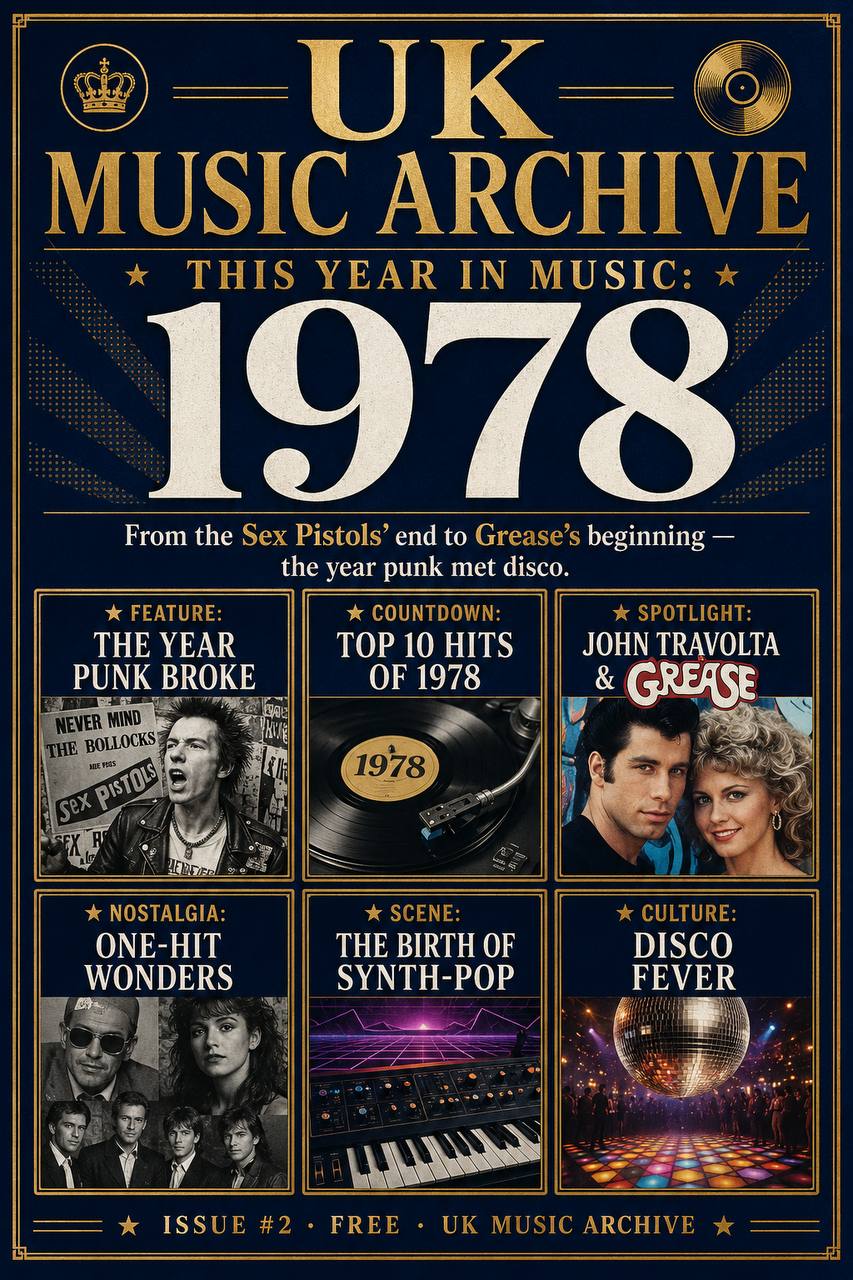
1978 Magazine Cover

Page 1 of 10

Welcome to 1978

The year punk met disco

1978 was the year British music split in two. On one side, punk was in its death throes — the Sex Pistols had imploded, the movement was fragmenting, and the safety-pin-and-spike aesthetic was giving way to something new. On the other side, disco was taking over the world. Saturday Night Fever had everyone in white suits and flared trousers. The Bee Gees were everywhere.

And in the middle, something else was stirring. A teenager in Bristol was building a synthesiser in his bedroom. Kraftwerk's "Trans-Europe Express" had inspired a generation of electronic pioneers. The first stirrings of what would become synth-pop, post-punk, and new wave were bubbling under the surface.

1978 was also the year of Grease, the year John Travolta cemented his status as the biggest star on the planet, and the year a young Mark Williams was born into a world of three TV channels, woolly jumpers, and the unmistakable sound of a nation finding its feet after the chaos of the 70s.

This is the story of 1978 — told through the songs that made it.

1978 by the Numbers

The year in stats
295
Songs Charted
189
Artists
41
Weeks of Charts
24
Different #1s

Page 2 of 10

The Big Moments

What happened in 1978

January: The Sex Pistols' US tour ends in disaster — the band splits in San Francisco. Sid Vicious is arrested for the murder of Nancy Spungen. Punk's great hope dies in a hotel room.

February: "Saturday Night Fever" soundtrack dominates the charts. The Bee Gees hold the top two spots simultaneously — a feat not achieved since The Beatles.

April: John Travolta and Olivia Newton-John's "You're the One That I Want" from Grease hits #1. It stays for 9 weeks — the longest run of the year.

June: The first Glastonbury Festival in 7 years takes place. 500 people attend. The headline acts include Fairport Convention and a then-unknown Kate Bush.

August: Kate Bush enters the chart at #1 with "Wuthering Heights" — the first female artist to have a self-written #1. She's 19 years old.

October: The Clash release "Give 'Em Enough Rope" — their second album and their first to crack the US market. Punk is evolving into something more political, more global.

December: Boney M's "Mary's Boy Child" is Christmas #1 — a disco-infused carol that proves even Jesus couldn't escape the dancefloor in 1978.

Did You Know?

The stories behind the stats
👑

"You're the One That I Want" spent 9 weeks at #1 — the longest run of the year. John Travolta and Olivia Newton-John's Grease duet was unstoppable.

🎤

Kate Bush's "Wuthering Heights" was inspired by Emily Brontë's novel. She wrote it aged 18 after seeing the final page of the book. It remains one of the most unique #1s ever.

The Boomtown Rats' "Rat Trap" was the first punk-influenced song to hit #1. Bob Geldof's band proved punk could be commercially successful.

💃

The Bee Gees had six #1s in the US and UK combined in 1978. They were the biggest pop group in the world, dominating with falsetto harmonies and disco beats.

🎸

Dire Straits' "Sultans of Swing" was their debut single, released in 1978. It reached #8 and launched a career that would define 80s rock. Mark Knopfler's fingerpicking style was unlike anything else.

🏴󠁧󠁢󠁥󠁮󠁧󠁿

"Matchstalk Men and Matchstalk Cats and Dogs" by Brian and Michael hit #1 — a tribute to the artist L.S. Lowry. It's one of the strangest #1s of the decade.

Page 3 of 10

Month by Month

The #1 that ruled each month
January
Mull of Kintyre
Wings
February
Uptown Top Ranking
Althea & Donna
March
Take a Chance on Me
ABBA
April
Night Fever
Bee Gees
May
You're the One That I Want
John Travolta & Olivia Newton-John
June
You're the One That I Want
(still)
July
You're the One That I Want
(still)
August
Wuthering Heights
Kate Bush
September
Summer Nights
John Travolta & Olivia Newton-John
October
Summer Nights
(still)
November
Rat Trap
Boomtown Rats
December
Mary's Boy Child
Boney M

Longest #1 Runs

Who stayed at the top longest

John Travolta & Olivia Newton-John — "You're the One That I Want" — 9 weeks

John Travolta & Olivia Newton-John — "Summer Nights" — 7 weeks

Bee Gees — "Night Fever" — 3 weeks

Kate Bush — "Wuthering Heights" — 4 weeks

Wings — "Mull of Kintyre" — 2 weeks (carried from 1977)

💡 The Grease Effect

Grease soundtrack songs spent a combined 24 weeks at #1 in 1978 — more than half the year. The Grease soundtrack was the best-selling album of the year.

Page 4 of 10

The Year Punk Met Disco

1978 and the great musical divide

1978 was a year of two tribes. On one side, punk was dying — but its influence was spreading. On the other, disco was reaching its commercial peak. And neither side could stand the other.

The Death of Punk

The Sex Pistols' US tour in January 1978 was a disaster. Johnny Rotten quit on stage in San Francisco. Sid Vicious was arrested for murder. The band that had defined the punk movement was over. But punk didn't die — it transformed. The Clash released "Give 'Em Enough Rope", a more polished, political album. The Jam were evolving from punk into mod revival. The Buzzcocks, Wire, and Magazine were pushing punk into art rock. What emerged was post-punk — smarter, weirder, and more lasting than its parent genre.

The Rise of Disco

Meanwhile, disco was conquering the world. Saturday Night Fever had made the Bee Gees superstars — three white men from the Isle of Man singing in falsetto over a four-on-the-floor beat. Disco was everywhere: on the radio, in the clubs, on TV. It was the sound of escape — from the economic hardship of the 70s, from the grey drizzle of British life, from everything.

"1978 was the year the dancefloor became more important than the stage."

The Birth of New Wave

And then there was the third way. Bands like The Police, Dire Straits, Elvis Costello, and the Boomtown Rats were taking the energy of punk and the melody of pop and creating something new. New wave was smarter, more musical, and more radio-friendly than punk. It was punk in a suit and tie. It was the sound of the future.

Page 5 of 10

Top 10 of 1978

The songs that defined the year

10. ABBA — "Take a Chance on Me"
The Swedish foursome were at their peak. A perfect pop song about persistence in love — and that call-and-response chorus is pure genius.

9. Bee Gees — "Stayin' Alive"
Released in late 1977 but dominated 1978. The definitive disco track. The walking bassline. The falsetto. The white suit. It defined an era.

8. The Boomtown Rats — "Rat Trap"
The first punk-inspired #1. Bob Geldof snarled his way through a song about small-town desperation. It was angry, catchy, and completely unexpected.

7. 10cc — "Dreadlock Holiday"
"I don't like cricket, oh no — I love it." A reggae-pop masterpiece that's one of the most recognisable hooks of the decade. It was 10cc's last major hit.

6. Boney M — "Rivers of Babylon"
A disco reimagining of a Biblical psalm. It spent 5 weeks at #1 and became one of the best-selling singles of the year. Disco had officially absorbed everything.

5. Dire Straits — "Sultans of Swing"
Mark Knopfler's fingerpicking guitar introduced a new kind of rock to the world. Laid-back, literate, and effortlessly cool. It still sounds timeless.

4. Kate Bush — "Wuthering Heights"
An 18-year-old girl from Kent singing in a high register about a Victorian novel. It had no business being a #1. It became one of the most iconic songs of the decade.

3. Bee Gees — "Night Fever"
The second single from the Saturday Night Fever soundtrack. A flawless disco record with a bassline that's still studied by musicians today. Three weeks at #1.

2. John Travolta & Olivia Newton-John — "Summer Nights"
The second Grease single, following "You're the One That I Want" at #1. Seven weeks at the top between August and November. Grease-mania was real.

1. John Travolta & Olivia Newton-John — "You're the One That I Want"
Nine weeks at #1. The longest run of the year. The defining sound of 1978. A duet about teenage lust set to a disco beat. It was unstoppable. It still is.

Page 6 of 10

One-Hit Wonders

The songs that came, went, and never came back

Althea & Donna — "Uptown Top Ranking" (1978)
Two teenage girls from Jamaica recorded this reggae track in a single take. It reached #1 in the UK and they became instant stars. They never had another hit. They didn't care. They'd made their point.

Brian and Michael — "Matchstalk Men and Matchstalk Cats and Dogs" (1978)
A tribute to the painter L.S. Lowry, delivered in a spoken-word Mancunian accent over a folk melody. It went to #1. It remains one of the strangest chart-toppers in British history.

Johnny Mathis — "Too Much, Too Little, Too Late" (1978)
A duet with Deniece Williams. Smooth, soulful, and utterly of its time. It hit #3 and was his first top 10 hit in 20 years. Nothing after came close.

Wings — "Mull of Kintyre" (1977, carried into 1978)
Paul McCartney's bagpipe-led folk song was the Christmas #1 of 1977 and spent weeks in the 1978 charts. It became the biggest-selling single in UK history at the time. McCartney would never top it.

The Sound of 1978

The genres that defined the year
35%
Disco / Dance
20%
Pop
18%
Rock
12%
New Wave / Punk
15%
Other

Page 7 of 10

Kate Bush

★ Artist Spotlight

She was 19 years old, from a farming family in Kent, and she'd just written a song inspired by a 130-year-old novel about a ghost on the Yorkshire moors. "Wuthering Heights" spent four weeks at #1 in 1978, making Kate Bush the first female artist to have a self-written #1 single. She didn't look like a pop star, she didn't sound like anyone else, and she didn't care.

Discovered by David Gilmour of Pink Floyd when she was 16, Kate was given time to develop. She took dance lessons, studied mime, and built a theatrical performance style that was unlike anything in pop music. The video for "Wuthering Heights" — her dancing in a red dress across a misty landscape — became one of the most iconic music videos of the era.

Kate Bush proved that weird could be commercial. That intelligence and pop music could coexist. That a teenage girl with a high voice and a book about Cathy and Heathcliff could conquer the world. She paved the way for every female artist who wanted to do things her own way. And she did it all before she was old enough to drink.

1978 in Context

What else was happening

In the UK: The Winter of Discontent saw widespread strikes across the country. The Labour government was losing control. Margaret Thatcher was waiting in the wings for the 1979 election. The three-day week was a recent memory. Britain was cold, grey, and ready for change.

In music: The first Glastonbury in 7 years took place (500 people). The last Sex Pistols show happened. Kate Bush conquered the world. Grease conquered everything else. And in a small bedroom in Bristol, a teenager named Geoff Barrow (later Portishead) was listening to his parents' records and dreaming of trip-hop.

Page 8 of 10

The Grease Phenomenon

How a 50s nostalgia musical took over 1978

Grease was released in June 1978 and became the highest-grossing musical film of all time. It wasn't just a movie — it was a cultural event. John Travolta went from TV star (Welcome Back, Kotter) to global icon in the space of a summer. Olivia Newton-John shed her country-pop image and became Sandy, the good girl who goes bad at the end.

The soundtrack spent 13 weeks at #1 in the UK album chart. Four singles were released, two of which spent a combined 16 weeks at #1 in the singles chart. "You're the One That I Want" was the biggest — 9 weeks at the top, the longest-running #1 of the entire decade until 1991.

The film sparked a revival of 1950s fashion — leather jackets, poodle skirts, and slicked-back hair were suddenly everywhere. School proms became a thing in the UK. Sleepovers involved Grease singalongs. It was a phenomenon that crossed generations.

🎬 Behind the Scenes

John Travolta was paid $250,000 for Grease. The film grossed over $396 million worldwide. The hand jive scene was choreographed in one day. Stockard Channing (Rizzo) was only 6 years older than Travolta but played a teenager.

The Birth of New Wave

Punk's smarter cousin

While the Sex Pistols were imploding, a new generation of bands was emerging. The Police formed in 1977 and released their debut single "Roxanne" in 1978. Elvis Costello released "This Year's Model" — a snarling, intelligent album that mixed punk energy with pop craftsmanship. The Boomtown Rats proved punk-influenced music could top the charts.

New wave wasn't a genre — it was an attitude. It took the DIY ethos of punk, added melody and musicality, and created something more accessible. It was punk for people who didn't want to spit on each other. It was the sound of Britain in transition — angry but hopeful, chaotic but melodic.

Page 9 of 10

Odd Facts

The weird stuff that happened
🎵 Random Trivia

The bagpipe solo on Wings' "Mull of Kintyre" was performed by a local pipe band from Campbeltown. Paul McCartney conducted them from a helicopter to get the right sound.

📺 TV Moment

Kate Bush's first TV performance of "Wuthering Heights" was on The Old Grey Whistle Test. Bob Harris introduced her as "a young lady from Kent with a rather remarkable voice." She danced across the studio in a red dress and left the nation speechless.

🏆 Chart Battle

August 1978 saw "Wuthering Heights" battle "Summer Nights" for #1. Kate Bush won for four weeks before Grease-mania took over again. It was the closest chart race of the year.

🔄 The Comeback

The Bee Gees' "Stayin' Alive" was originally written with a different title — "Saturday Night". The filmmakers asked them to write a song that captured the feeling of walking through New York. They wrote it in one afternoon.

1978 at a Glance

The year in 60 seconds
🎵

Biggest song: "You're the One That I Want" — 9 weeks at #1. Unstoppable.

💿

Biggest album: Grease soundtrack — spent 13 weeks at #1 in the album chart.

🏟️

Biggest gig: The last Sex Pistols show at Winterland, San Francisco (January 14, 1978).

🌟

Breakthrough artist: Kate Bush — 19 years old, first female self-written #1.

🎬

Biggest film: Grease — highest-grossing musical film of its time.

🇬🇧

Best selling single: "Mull of Kintyre" / "Girls' School" by Wings — the biggest-selling single in UK history at that point.

— End of Issue —

Page 10 of 10