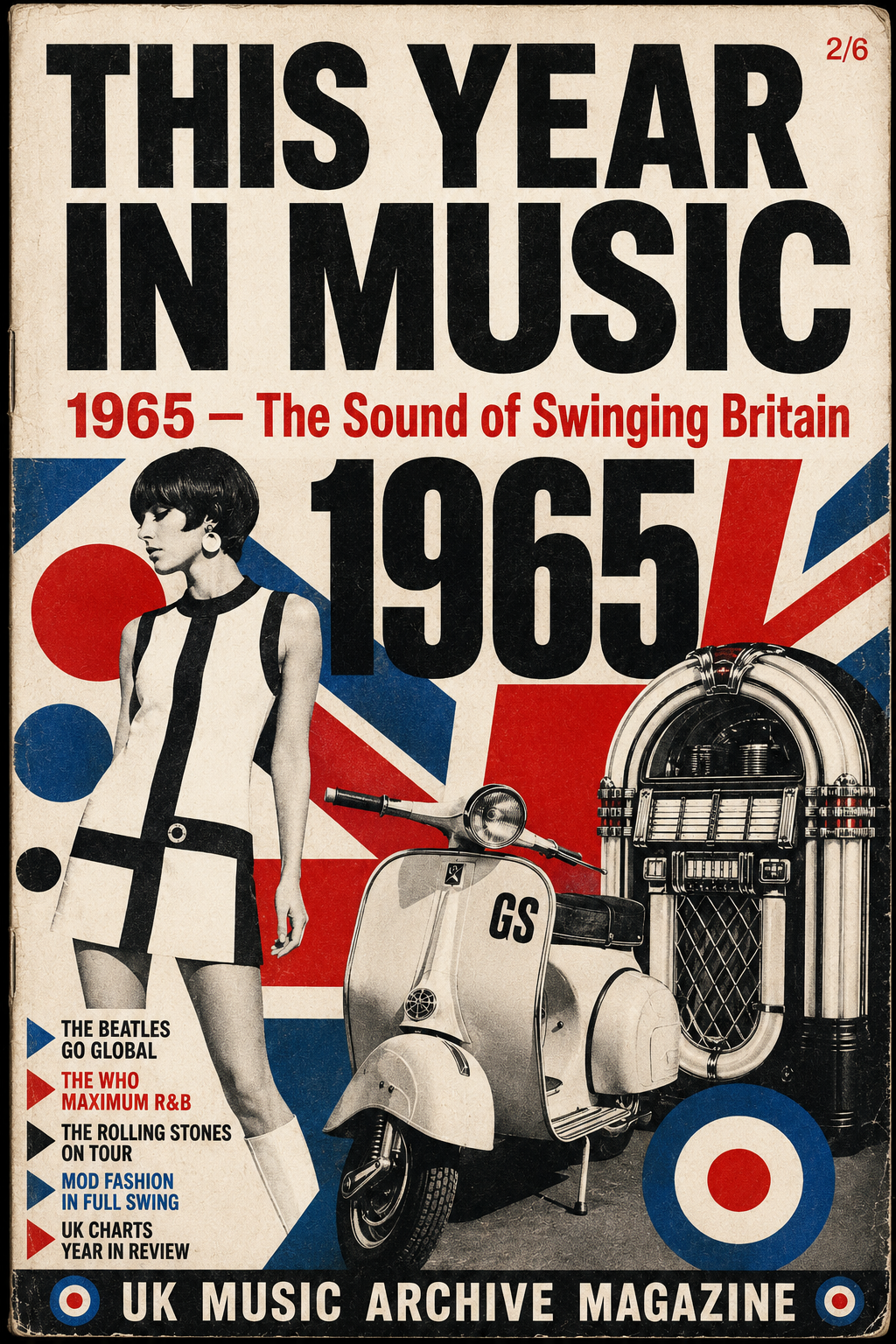
1965 Magazine Cover

Page 1 of 10

Welcome to 1965

The year Britain took over the world

1965 was the year British music stopped being a curiosity and became a global force. The Beatles dominated everything β€” they had three separate #1s, headlined Shea Stadium to 55,000 screaming fans, and released Help! and Rubber Soul in the same year. The Rolling Stones found their snarling identity with "(I Can't Get No) Satisfaction". The Who smashed their gear on TV. The Kinks wrote songs about nothing that somehow meant everything.

But it wasn't just the big names. Tom Jones announced himself with "It's Not Unusual". The Seekers became Australia's biggest export. Ken Dodd, a comedian from Knotty Ash, spent five weeks at #1 with "Tears". Sandie Shaw sang barefoot and owned the summer.

This is the story of 1965 β€” the year Britain decided it was the centre of the musical universe.

1965 by the Numbers

The year in stats
26
Different #1s
52
Weeks of Charts
22
#1 Artists
8
British #1s
πŸ’‘ Did You Know?

Ken Dodd's "Tears" spent 5 weeks at #1 β€” the longest run of the year. He was primarily known as a comedian. The song had been recorded 30 years earlier by Rudy VallΓ©e.

The Big Moments

What else happened in 1965

January: The Beatles' "I Feel Fine" still at #1 from Christmas. Churchill died. The entire nation mourned.

April: The Rolling Stones get their first UK #1 with "The Last Time" β€” a cover of a Staple Singers gospel song.

June: Tom Jones' "It's Not Unusual" becomes the soundtrack of the summer. His lecherous wiggle becomes a TV staple.

August: The Beatles play Shea Stadium β€” 55,000 people, the biggest concert of the era. The sound was terrible. Nobody cared.

October: Ken Dodd's "Tears" reaches #1 for the second time. The comedian with the buck teeth and the tickling stick ruled the charts.

Page 2 of 10

Did You Know?

The stories behind the stats
🎀

"You've Lost That Lovin' Feelin'", The Righteous Brothers β€” the longest single ever released at 3:45. Radio stations refused to play it. It hit #1 anyway.

🎸

"Satisfaction" was written in Keith Richards' sleep. He woke up, played the riff into a tape recorder, and went back to sleep. That tape still exists.

πŸ‡¦πŸ‡Ί

The Seekers had two #1s in 1965 β€” "I'll Never Find Another You" and "The Carnival Is Over". They were from Melbourne, Australia.

πŸŽͺ

Ken Dodd's "Tears" spent 5 weeks at #1 but was banned by the BBC for "excessive sentimentality" on some radio shows.

πŸ‘’

Sandie Shaw sang "Long Live Love" in bare feet on TV. It became her trademark. She was 18 years old.

🎢

"Mr Tambourine Man" was written by Bob Dylan. The Byrds took it electric, added harmonies, and created folk-rock in one session.

Odd Facts

The weird stuff that happened
🎡 Random Trivia

The Moody Blues' only #1 β€” "Go Now" β€” sounds nothing like everything else they'd later become famous for. It was a cover of a B-side by Bessie Banks.

πŸ‡¬πŸ‡§ British Invasion

In July 1965, American Billboard chart had 7 of the top 10 by British acts. The so-called "British Invasion" was at full intensity.

πŸ”„ Cover Wars

"Ticket to Ride" by The Beatles spent 3 weeks at #1 in the UK. An orchestral cover by The Hollyridge Strings also charted. It did not fare well.

Page 3 of 10

Month by Month

The #1 that ruled each month
January
I Feel Fine
The Beatles
February
You've Lost That Lovin' Feelin'
Righteous Brothers
March
I'll Never Find Another You
The Seekers
April
The Last Time
Rolling Stones
May
Ticket to Ride
The Beatles
June
Long Live Love
Sandie Shaw
July
Crying in the Chapel
Elvis Presley
August
Help!
The Beatles
September
I Got You Babe
Sonny & Cher
October
Tears
Ken Dodd
November
Get Off of My Cloud
Rolling Stones
December
Day Tripper / We Can Work It Out
The Beatles

Longest #1 Runs

Who stayed at the top longest

Ken Dodd β€” "Tears" β€” 5 weeks

The Beatles β€” "Help!" β€” 3 weeks

The Rolling Stones β€” "The Last Time" β€” 3 weeks

Sandie Shaw β€” "Long Live Love" β€” 3 weeks

The Hollies β€” "I'm Alive" β€” 3 weeks

The Seekers β€” "The Carnival Is Over" β€” 3 weeks

The Beatles β€” "Day Tripper / We Can Work It Out" β€” 3 weeks

Page 4 of 10

The Year of British Pop

How 1965 became the year Britain ruled the charts

1965 was the year British pop music went global. Not just the Beatles β€” though they were still the biggest thing on the planet β€” but an entire generation of British bands who proved that the UK wasn't just America's little music cousin.

The year kicked off with "I Feel Fine" still at #1 from 1964. That song started with feedback β€” deliberately recorded feedback, the first pop single to open with guitar feedback. It was a tiny, accidental moment that said everything about where music was heading.

The British Invasion Peaks

By mid-1965, the British Invasion of America was at its absolute height. The Beatles, Rolling Stones, The Who, The Kinks, Herman's Hermits, Petula Clark, Dusty Springfield β€” British artists dominated American radio. The Beatles' Shea Stadium concert in August was the loudest, biggest, most chaotic event pop music had ever seen. 55,000 people. Mostly teenage girls. Mostly screaming so loudly the band couldn't hear themselves play.

"In 1965, British music stopped sounding like it was trying to copy America and started sounding like itself."

The Rise of the Singer-Songwriter

1965 saw the beginning of the singer-songwriter era. Dylan went electric at Newport in July. The Beatles released Rubber Soul in December β€” the album where they stopped being a pop band and started being artists. "Norwegian Wood" introduced the sitar to Western pop. Lennon wrote "In My Life" about real people, real places, real memories. Pop music was growing up, and 1965 was the turning point.

Page 5 of 10

Top 10 of 1965

The songs that defined the year

10. The Byrds β€” "Mr Tambourine Man"
Bob Dylan wrote it. The Byrds electrified it. The jangly 12-string Rickenbacker sound that launched a thousand imitators.

9. The Kinks β€” "Tired of Waiting for You"
A darker, slower Kinks than "You Really Got Me". Ray Davies proving he could write melancholy as well as mayhem.

8. Tom Jones β€” "It's Not Unusual"
Written for Sandie Shaw, who turned it down. Tom Jones made it one of the most iconic singles of the decade. That opening horn riff is instant 1965.

7. The Righteous Brothers β€” "You've Lost That Lovin' Feelin'"
Produced by Phil Spector at his most maximalist. The longest single ever released at the time. Radio stations thought it was too long. The public disagreed.

6. The Seekers β€” "I'll Never Find Another You"
A folk-pop masterpiece from Australia. Judith Durham's voice carried it to #1 on both sides of the world.

5. The Rolling Stones β€” "The Last Time"
The Stones' first UK #1. A gospel song turned into a snarling rock single. The beginning of the Jagger-Richards writing partnership.

4. Bob Dylan β€” "Like a Rolling Stone"
Six minutes long. Three chords. No chorus. Changed everything. "How does it feel?" indeed.

3. The Beatles β€” "Help!"
The title track from their second film. Written as a genuine cry for help β€” Lennon later admitted he was overweight, depressed, and overwhelmed.

2. The Rolling Stones β€” "(I Can't Get No) Satisfaction"
That riff. That fuzz pedal. That song about commercialism and alienation that became the anthem of a generation. The defining single of 1965.

1. The Beatles β€” "Ticket to Ride"
Lennon's favourite Beatles single. A heavier, darker sound than anything they'd done before. The drums alone announced that pop music had changed forever.
Page 6 of 10

One-Hit Wonders

The songs that came, went, and never came back

The Moody Blues β€” "Go Now" (1964–65)
Their only #1. A soulful, piano-driven ballad. Within two years, Justin Hayward and John Lodge would join, the band would reinvent themselves as prog-rock pioneers, and "Go Now" would feel like a different band entirely (because it was).

Unit Four Plus Two β€” "Concrete and Clay" (1965)
A gentle, harmony-driven pop song that went to #1. The band had one more minor hit and disappeared. Thirty years later, a cover by Randy Edelman appeared on a compilation and nobody remembered the original.

The Walker Brothers β€” "Make It Easy on Yourself" (1965)
Scott Walker's voice was something else β€” a deep, dramatic baritone that belonged on a stage, not in a pop band. They had two more hits and split. Scott Walker went on to make some of the strangest, most beautiful music of the 20th century.

Jackie Trent β€” "Where Are You Now (My Love)" (1965)
A singer and songwriter who co-wrote for Petula Clark and others. This was her only #1 as a performer. She later moved to Australia and became a TV personality.

The Sound of 1965

The genres that defined the year
40%
Beat / Pop
25%
Folk / Folk-Rock
20%
R&B / Soul
10%
Rock 'n' Roll
5%
Easy Listening

Page 7 of 10

The Beatles

β˜… Artist Spotlight

If 1965 had a soundtrack, it was the Beatles'. They started the year at #1 with "I Feel Fine", dominated spring with "Ticket to Ride", owned summer with Help!, and ended the year with the double A-side "Day Tripper / We Can Work It Out" still at the top.

But 1965 was about more than just singles. Rubber Soul, released in December, was the album that changed everything. It wasn't a collection of songs with filler β€” every track mattered. "Norwegian Wood" introduced the sitar. "Nowhere Man" was a song about a man who wasn't sure he wanted fame. "In My Life" was Lennon writing autobiography set to music.

In August, they played Shea Stadium β€” the first stadium concert in rock history. 55,000 fans. The band couldn't hear a thing. They played through sheer muscle memory. When it was over, they were driven away in an armoured car.

1965 was the year the Beatles stopped being a pop group and started being the most important cultural force of the decade.

1965 in Context

What else was happening

In the UK: Winston Churchill died on 24 January, aged 90. His state funeral was the largest in British history. The death penalty was abolished. The first Post Office Tower opened in London. The Moors Murders trial dominated the news.

In the world: The Vietnam War escalated dramatically with US ground troops deployed. Malcolm X was assassinated in February. The Selma civil rights marches took place in Alabama. The Voting Rights Act was signed in August.

Page 8 of 10

The British Invasion

How the UK took over American radio

By 1965, the British Invasion of America was in full swing. It started in 1964 with the Beatles on Ed Sullivan β€” 73 million viewers, the highest-rated TV event of the era. By 1965, it was a full-blown occupation.

The Rolling Stones broke through with "(I Can't Get No) Satisfaction" β€” a snarling, fuzzed-out masterpiece that felt dangerous in a way the Beatles never did. The Kinks had "Tired of Waiting for You". The Who hadn't broken America yet, but "My Generation" was just around the corner. Herman's Hermits, perhaps the least cool band of the era, somehow had three US #1s.

The Numbers

In 1965, British acts held the #1 spot on the Billboard Hot 100 for 22 weeks out of 52. The Beatles alone spent 11 weeks at #1. American radio was playing more British music than American music, and nobody seemed to mind.

The Backlash

Of course, the backlash came. American musicians complained that British bands were stealing their sound and their audience. The US musicians' union threatened to ban British acts from touring. It never happened. The British Invasion rolled on until 1967, when psychedelia and the Summer of Love changed everything again.

Page 9 of 10

The Folk Revival

1965 and the year acoustic went electric

The biggest controversy in music in 1965 wasn't about the Beatles or the Stones. It was about Bob Dylan going electric at the Newport Folk Festival in July. The crowd booed. Pete Seeger reportedly tried to cut the power cables with an axe. Folk purists were outraged.

But Dylan didn't care. He'd already released "Like a Rolling Stone" a week before β€” six minutes of poetic fury that proved electric music could carry serious lyrical weight. The song reached #4 in the US and #2 in the UK. A song about a debutante who fell from grace, set to the most aggressive organ sound anyone had ever heard on a pop record.

The Byrds took Dylan's "Mr Tambourine Man", added harmonies and a 12-string Rickenbacker, and created an entirely new genre: folk-rock. The Seekers brought folk-pop from Australia. Simon & Garfunkel would arrive next year. 1965 was the crossroads where acoustic met electric, and both were changed forever.

1965 at a Glance

The year in 60 seconds
🎡

Biggest song: The Rolling Stones β€” "(I Can't Get No) Satisfaction". That riff defined a generation.

πŸ’Ώ

Biggest album: The Beatles β€” "Rubber Soul". The album that proved pop could be art.

🏟️

Biggest gig: Shea Stadium β€” 55,000 people watched the Beatles in the first stadium rock concert.

πŸ“Ί

Biggest TV moment: Dylan goes electric at Newport Folk Festival β€” folk purists booed, history cheered.

πŸ†

Most weeks at #1: Ken Dodd β€” "Tears" (5 weeks). A comedian from Liverpool ruled the charts.

πŸ‡¬πŸ‡§

Best selling single: The Beatles β€” "Help!" The cry for help that became a global smash.

β€” End of Issue β€”

Page 10 of 10